
Empowering Civil Servants Through AI and Low Code: Building from the Inside Out
Low Code & Government
In recent months, headlines have been filled with ambitious announcements about how the UK government plans to embrace artificial intelligence. From initiatives to position Britain as a global AI leader to investments in public computing and the creation of AI growth zones, the direction of travel is clear.
But at the Global Government Innovation Forum in March, during our session on the Impact Stage at the ExCeL Centre, we explored something more grounded. A kind of transformation that is already happening. One that starts not with high-level strategies but with the people inside government who are closest to the problems.
Our session, Empowering Civil Servants through AI, Agents, and Low Code, focused on what becomes possible when civil servants are given the tools and confidence to solve problems themselves.
Civil Servants Are Users (and Humans) Too
It is worth restating something that should be obvious but is often overlooked: civil servants are users too.
Over the past decade, government digital efforts have rightly focused on citizen-facing services. Service design, agile delivery, and user research have all helped make public services clearer, faster, and easier to use. Internally, however, many civil servants still face clunky tools, complex processes, and a heavy reliance on centralised delivery teams.

The task now is to extend the same principles of user-centred design and empowerment to the inside of government. Because when civil servants are enabled to build their own solutions, the results can be extraordinary.
Four Personas Driving Change
To help explain the shifts we are seeing, here are four personas:

- Pricilla represents traditional IT. She manages large, secure systems that are essential to government but are often inflexible and slow to change.
- Adam came from the early days of digital government. Alex helped develop standards and redesign services but mainly focused on citizens rather than civil servants.
- Kareem is a DDaT leader in a major department. He is trying to bring agile ways of working into complex environments while managing legacy infrastructure and policy demands.
- Ian works in a policy or operations team. He is not a developer, but he is digitally curious. Ian finds ways to solve problems for his team using low code, no code, and AI tools.
Ian is central to the story. With the right tools and support, Ian can deliver real improvements without waiting months for a centrally delivered solution. By doing this, he reduces reliance on specialists and unlocks faster, more locally relevant innovation.
Example 1: Turning On the Tools and Letting Them Work
In one organisation we worked with, the transformation began with a simple act: they turned on the Power Platform. This included access to citizen developer tools such as low-code, no-code, and generative AI capabilities. There was no internal campaign, just access made available quietly.
Soon, Ian started to appear. Staff across the organisation began building apps, automating tasks, and solving pain points they understood deeply. These were not digital professionals. They were people who saw problems and started fixing them.

Instead of shutting this activity down, the organisation asked how to support it safely. We helped them build a framework for governance, onboarding, testing, and responsible scaling. The goal was not just to manage the tools but to support the people using them.
This is how transformation can scale in a sustainable way. It comes not from the top alone but from distributed initiative that is aligned to shared principles.
Examples 2 and 3: AI That Supports Rather Than Replaces
Artificial intelligence is also part of this story. But it is not about replacing civil servants. It is about giving them smarter tools to help with complex, repetitive, and time-consuming work.
We shared two examples during the session. The first involved an HR team overwhelmed by repetitive policy questions. We ran a two-day AI design sprint, built a prototype using Copilot Studio, tested it with real users, and proved the concept, all within three weeks. That assistant has now been developed and is in private beta within the organisation.
The second example focused on recruitment. Public sector hiring involves strict rules set by the Civil Service Commission. It is auditable, structured, and full of opportunities for mistakes. We discovered four main pain points through our design sprint and built an AI assistant to guide managers through the process, answer their questions, and flag risks before they become problems.
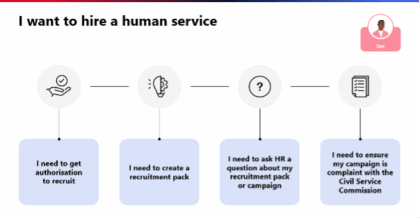
These are not hypothetical projects. They are working proofs of how AI, when applied thoughtfully, can reduce friction and support better outcomes.
Looking Ahead
We are starting to see the shape of the civil servant of the future. Someone who is less dependent on central delivery teams and more empowered to design and build hyper-local solutions. Someone who has the tools to respond quickly to user needs, whether they are citizens, colleagues, or frontline staff.
This is not about disruption for its own sake. It is about solving real problems in ways that are faster, smarter, and more sustainable. And it is already happening. In pockets. In teams. Through individuals who see a better way and are quietly making it happen.
What This Means for You
If you are a civil servant, this shift is not just about technology. It is about possibility.
You do not need to be a developer to improve the way your team works. You do not need to wait for permission to try something small. And you are not alone if you are frustrated by process-heavy workarounds that do not serve the user.
What is changing now is that the tools are finally catching up to your intent. AI, low code, and no code platforms can help you build for your own team and test what better looks like in practice.
So the question becomes: what is the small thing you would fix if you could?
Because chances are, now you can.
Join the Low Code Movement
Join a growing movement of civil servants and digital leaders who are driving innovation, empowering teams, modernising services, and unlocking productivity through low code platforms.
➡️ See our upcoming Government low code Events
Want to build your business case for innovating with low-code, AI and agents and understand how to mitigate risk with best practice governance models? Attend our in-person September workshop brought to you in collaboration with the cross-government Low Code Community of Practice and Government Transformation Magazine to demystify the value of Low Code for your organisation.
Demystifying Low Code: Managing Risks and Leveraging Opportunities
🔔 Date: Tuesday, September 9th
⏰ Time: 10:30 AM – 2:30 PM
📍 Location: London